PUBG Anti-ESP Fog of War: How the Anti-Cheat Team Blinds Wallhack Users
PUBG Anti-ESP Fog of War counters ESP wallhacks by hiding unseen players, reducing illegal long-range kills and damage.
It was a familiar nightmare in the hills of Miramar. A lone survivor crawled through tall grass, silent and unseen—until a single shot arrived from across the ridge. The shooter had no line of sight, no drone, no teammate callout. Yet the killcam revealed the impossible: the enemy had tracked every movement as if the terrain did not exist. This was not skill. It was ESP.
What exactly is ESP?
Extra Sensory Perception, or ESP, is an illegal software that automatically pinpoints other players' positions in a match. It gathers information about where opponents are and presents that data visually, typically with boxes, text, or overlays. In a shooter where stealth, sound, and sightlines decide fights, this violates the core of fair competition. The PUBG: BATTLEGROUNDS Anti-Cheat Team has described ESP as one of the most frequently encountered cheating methods and a significant source of community stress.
Why is ESP so difficult to fight? Unlike some unauthorized programs, ESP does not tinker directly with game data. It leaves no trace on existing files. From a monitor's third-person perspective, ESP usage can be nearly invisible when reviewing in-game reports. This led the team to a different strategy: rather than only detecting ESP users, they would make ESP useless.
A solution called Fog of War
The result was Anti-ESP, also referred to as Fog of War in strategy simulations. The concept is straightforward but powerful. Anti-ESP disrupts illegal software by eliminating location details of players who are out of sight. If a player is hidden behind a wall, beyond a ridge, or outside the normal visual range, that position is not transmitted to the client. A cheater cannot identify what is not there.
The challenge was enormous. The game still needed location, sound, and behavior data for replays and death cams, while ensuring live matches did not expose unseen positions to clients. The Anti-Cheat Team built a system that balances those needs.
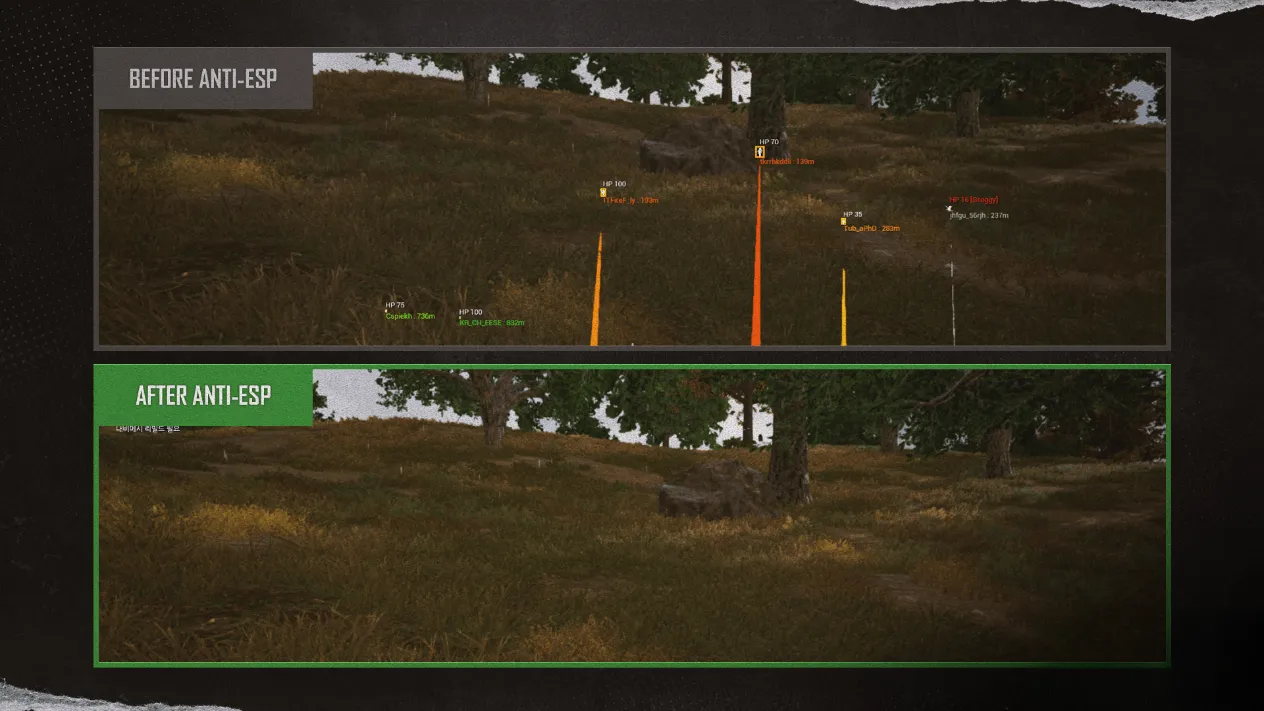
The visual evidence quickly became a defining image. In one view, with Anti-ESP disabled, the locations of other players were visible. With Anti-ESP enabled, the screen appeared as it should, with only legitimate sightlines.
The numbers behind the fog
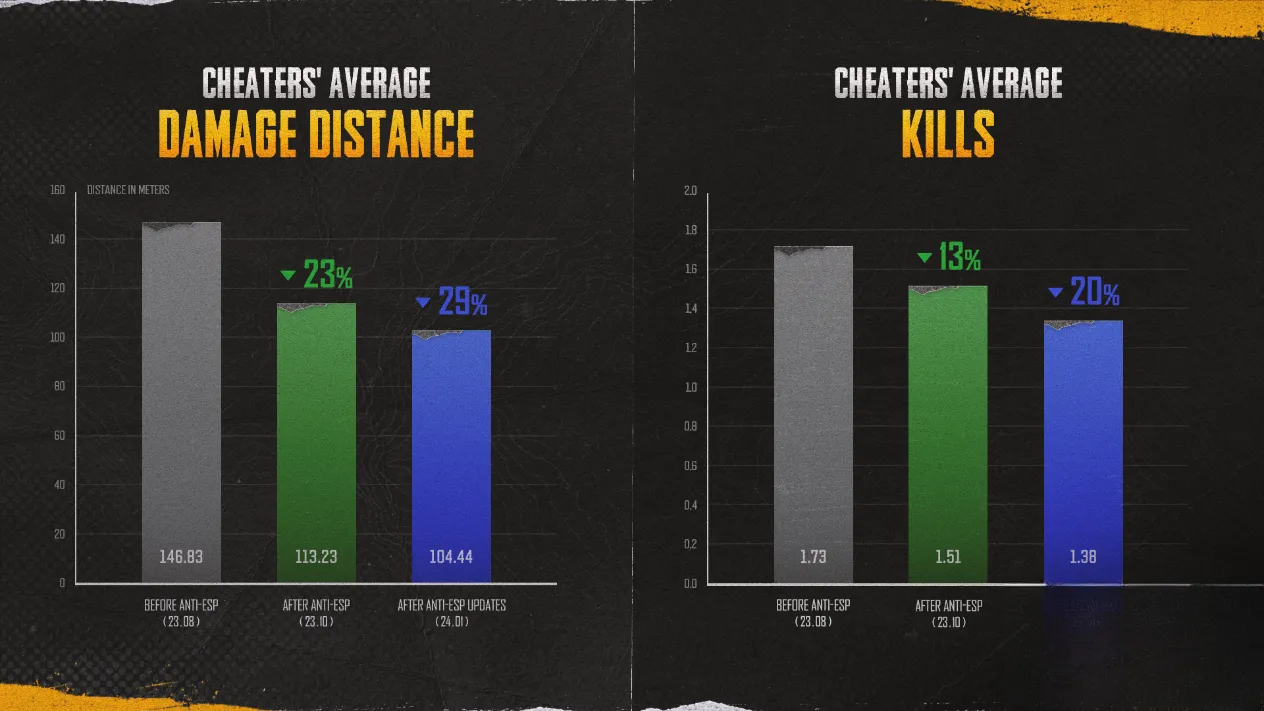
After internal testing, Anti-ESP went live in September 2023. Further security enhancements followed in December 2023, January 2024, and March 2024. The effects on cheater behavior were measurable.
| Cheater metric | Observed change |
|---|---|
| Average distance of in-game damage | Reduced by about 23% after Anti-ESP was introduced |
| Overall damage-distance decrease | Approximately 30% compared with August 2023 after January 2024 enhancements |
| Average kills per match | Decreased by roughly 20% after implementation and upgrades |
These shifts meant fewer impossible long-range kills, fewer wall-tracking engagements, and less advantage from using illegal overlays.
A living system, not a static shield
Anti-ESP is not a one-time patch. The team continuously pursues improvements in world texture, server performance, and replay/death cam graphic refinements when Anti-ESP is enabled. In November 2023, priorities centered on optimizing servers, replays, and death cams. Updates in December, January, and March focused on better in-game graphics and additional security measures.
Beyond ESP
While eliminating the unfair advantage of ESP remains central, the team also focuses on the fundamental step of detecting illegal software. The community had reported various illegal functions, including one that enabled abnormal vehicle driving. The Anti-Cheat Team strengthened countermeasures and signaled that additional actions were underway.
The road ahead
By 2026, Anti-ESP has become a core part of PUBG's anti-cheat philosophy—not merely a one-time fix but an evolving red line between legitimate perception and stolen information. The work on world textures, server load, and replay consistency continues because every new map object or movement system could be another potential line-of-sight that needs protection.
The question for cheaters was never whether they could hide. It was whether the game would stop telling them where everyone was. In many matches now, the answer is no. And for ordinary players, that silence is exactly how fair play should feel. After all, in a battle royale, the only sixth sense should be experience, not software.